Brandon Johnson Tried to Bury Rahm. He Ended Up Making the Case for 2028.
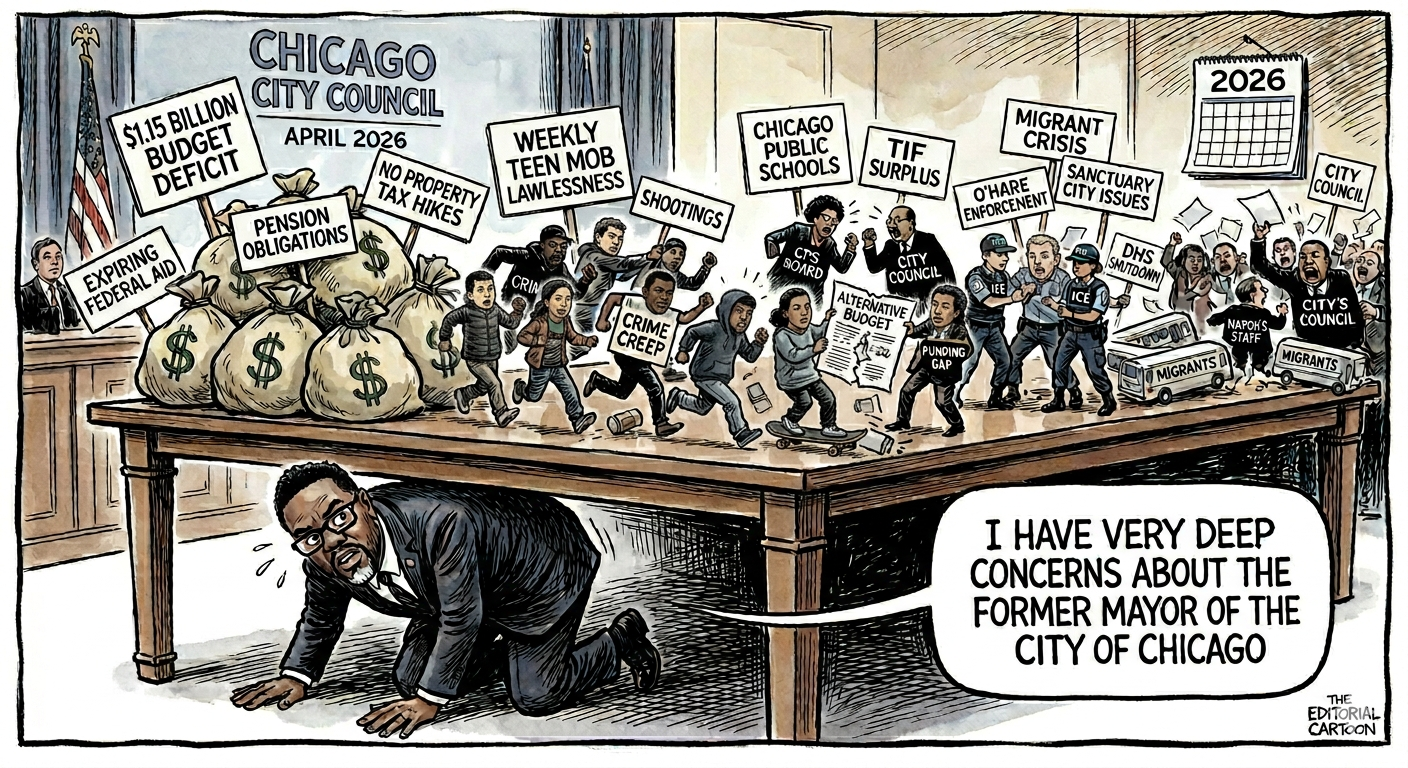
City of Chicago Mayor Brandon Johnson used his April 16 appearance on WBEZ-FM’s “Ask the Mayor” to take a shot at Rahm Emanuel. He called Emanuel’s record “disqualifying,” pointed to “school closures,” “privatization,” and “austere budgets,” and invoked the Laquan McDonald case to argue that Emanuel’s years in office should count as a warning to voters. (The nerve on this guy.)
Fine. Let’s compare them.
Because Johnson is not attacking a mayor who sat in City Hall while Chicago drifted. He is attacking a mayor under whom Chicago cut its structural budget shortfall from $635.7 million to $97.9 million, drove unemployment down from 10.6% to 4.1%, added more than 160,000 jobs, and hit a tourism record of roughly 57.6 million visitors in 2018. Rahm made hard choices that drew blood because hard choices in a hard city always do. But Chicago moved. That is exactly what makes Johnson’s attack so revealing. He is condemning the kind of leadership he has not shown himself.
That is the real contrast. Rahm treated City Hall like a place where ugly problems had to be confronted. Johnson too often treats it like a place where every failure needs a villain and every hard choice gets one more delay, one more excuse, one more speech. Johnson tried to make Rahm Emanuel sound disqualifying. What he really did was remind people why Democrats looking for serious national leadership in 2028 may end up valuing exactly the kind of results-first leadership Rahm showed in Chicago.
Rahm dealt with the school math. Johnson keeps ducking it.
Johnson talks about the 2013 school closures as though Rahm Emanuel picked a fight for sport. The truth is that CPS had too many buildings and too few students. In 2013, the system had room for about 511,000 students and enrolled about 403,000, leaving roughly 100,000 empty seats. Today the mismatch is worse: CPS has capacity for a little over 450,000 students and enrollment of about 306,000, leaving roughly 144,000 empty seats. Rahm dealt with that reality. Johnson inherited an even more underused system and still offers no serious plan to right-size it.
Rahm’s approach produced movement. CPS graduation rose from around 60% in the mid-2000s to above 80% by 2019. Ninth-grade on-track rates improved. College enrollment and completion improved. Chicago expanded pre-K, backed the STAR scholarship, and secured roughly $450 million more in annual school funding through state formula changes.
Johnson inherited graduation around 84% in 2023. The headline number stayed high, but the substance looks weaker. Only about 10% of Black CPS students meet SAT reading benchmarks and about 8% meet math benchmarks. Enrollment keeps falling. Choice has narrowed. Johnson’s education politics are good at protecting institutions and allies. Families still have to live with the results.
Rahm shrank the deficit. Johnson is staring at a crater.
Budgets are where slogans go to die.
Rahm Emanuel entered office facing a $635.7 million operating budget shortfall for FY2012. By the time the city was projecting its FY2019 budget, that shortfall had been reduced to $97.9 million, a drop of more than 85%, with more than $650 million in savings, reforms, and efficiencies along the way. That is what hard fiscal choices look like. They are unpopular. They leave marks. They also move the books in the right direction.
Johnson is now staring at a projected $1.15 billion corporate-fund gap for 2026, after the city projected that 2025 would end with a $146 million deficit. His broader approach has leaned on temporary fixes, one-time resources, and softer structural discipline where harder choices are plainly needed. Rahm inherited a hole and shrank it. Johnson inherited a hard city and keeps reaching for delay.
That is Johnson’s fiscal style in one sentence: full-volume morality until arithmetic walks into the room. Then the speeches keep coming, the gimmicks come out, and the hard decision gets bumped to another day. City Hall under Johnson too often feels like a place where the check is always “in the mail.”
Johnson uses Laquan McDonald as a smear and one rule for Rahm, another for himself.
Johnson wants people to hear “Laquan McDonald” and stop thinking there. He borrows the full moral force of that tragedy and tries to pin it personally on Rahm Emanuel.
The facts are more precise. Jason Van Dyke killed Laquan McDonald. Van Dyke was prosecuted, convicted of second-degree murder and aggravated battery, and sentenced to prison. Federal prosecutors later said the federal-state investigation was “thorough and independent.” Former Inspector General Joe Ferguson said there was no evidence Emanuel covered up the murder.
The city’s handling of the video was a serious transparency failure. Nobody needs to soften that. But delayed release of a video is a different allegation from personally covering up a murder or rigging the criminal case to protect the officer. Johnson wants Rahm to wear Jason Van Dyke’s crime like a name tag. The facts do not let him do that cleanly.
And Johnson does not even apply his own standard to himself. Since he became mayor, examples of police misconduct still exist. Johnson did not call himself disqualified. He wants total blame when he is throwing rocks backward and nuance when the same questions land in his own office. You’d think that the weight of the office would temper his proclivity to smear his predecessor; perhaps he is taking cues from the current White House blamer-in-chief.
On crime, Johnson’s defenders point to homicide charts while residents keep feeling disorder.
This is where the Johnson defense usually retreats: homicides and shootings are down, therefore criticism of public order must be unfair. But cities are not experienced through year-end homicide tables alone. They are experienced in the gut, in whether downtown feels managed, in whether ordinary residents feel safe, and in whether it seems like somebody is actually in charge.
Under Rahm, violent crime fell materially over the decade. Total violent crime dropped from about 35,700 incidents in 2010 to about 27,600 by 2019. Under Johnson, homicide has fallen sharply from the pandemic peak. Chicago ended 2025 with 416 homicides, down 29% from 2024, the lowest since 1965, while shooting incidents fell 35% and shooting victims fell 34%. Nobody should deny those gains.
But Johnson’s public-order problem is bigger than homicide. It is a pattern. So-called teen takeovers had already been making headlines again by April 2025 and had been a trend for years. By then, Streeterville had already seen two high-profile shooting incidents in three weeks tied to these gatherings, including the March 9 shooting of a tourist and the March 28 melee in which one teen was shot, another was stabbed, and officers were injured trying to restore order. Then in March 2026, Chicago had already seen its first large teen takeover of the year in the Loop, with eight arrests and 24 curfew violations. That is not an isolated disruption. That is a pattern of disorder in the most visible part of the city.
The public feels that gap too. About two-thirds of Chicagoans say there is an area within a mile of home where they would be afraid to walk alone at night, and that figure held roughly steady across 2024 and 2025 at about 65% to 66%. Johnson wants full credit for lower homicide numbers while residents keep reporting a city that feels loose, tense, and one chaotic weekend away from another public spectacle.
The economy under Johnson still looks like a theory. Under Rahm, it looked like a priority.
Johnson frames his economic agenda around equity, redistribution, and neighborhood investment. Fine. Then show the movement. Chicago still has only 31 affordable homes for every 100 extremely low-income renter households, with a shortage of roughly 225,000 affordable rental units for its poorest residents. Against that backdrop, weak visible housing output and weak development momentum are not side issues. They are the issue.
Rahm governed with a different instinct and left numbers behind to show it. By the end of his tenure, Chicago had added more than 160,000 jobs, unemployment had fallen from 10.6% to 4.1%, tourism had reached a record 57.6 million visitors in 2018, and the city had attracted 58 corporate headquarters relocations and nearly 200 major business expansions translating into more than 50,000 jobs. Rahm treated growth like part of the job. He did not stand around waiting for theory to catch up with reality.
Johnson’s economic record still reads more like a concept than a surge. The current picture features weak building output, elevated office vacancy, and business anxiety about the city’s tax and regulatory posture. That is a lot of moral language for not much visible acceleration. Rahm pushed jobs, tourism, investment, housing, and visible development momentum with the mentality of a mayor trying to move the city. Johnson keeps offering a theory of fairness without showing enough growth, confidence, or output to make Chicago feel like it is moving at all.
Johnson Tried to Bury Rahm. He Exposed the Democratic Party’s Real Problem.
Brandon Johnson meant this as an attack on Rahm Emanuel. It lands more like a reminder of what kind of Democratic leadership is missing.
Because this is bigger than one mayor taking a shot at another. It is about two different instincts inside the Democratic Party. Johnson represents the politics that failed in 2024: terrified of offending organized interests, eager to promise transformation, forever speaking in the language of inclusion while using it to sort people into camps, and much more comfortable assigning blame than delivering results. That version of the party spends too much time trying to satisfy activists, insiders, and special-interest groups, and not enough time dealing with what most people actually care about: safe streets, good schools, affordable living, competent government, and whether the people in charge look like they know what they are doing.
Rahm Emanuel represents the opposite instinct. Less sentimental. More practical. More willing to challenge his own side. More willing to make enemies in order to get results. He understands that government is not a seminar and leadership is not a performance. It is decisions. It is tradeoffs. It is taking the hit. It is moving a city, or a country, forward even when the factions howl.
That is what makes Johnson’s attack so revealing. He wanted to make Rahm sound disqualifying. What he really did was remind Democrats why a results-first leader who can take on dysfunction, defy the interest groups, and deliver in the real world may be exactly what the party needs in 2028.
Johnson meant to disqualify Rahm. Instead, he made the case for him.